Email:export@gzliyin.com
WhatsApp:+8613902386325
Email:export@gzliyin.com
WhatsApp:+8613902386325
When evaluating acoustic panels, one technical term appears again and again: NRC.
But what exactly does NRC mean, and why is it so important when choosing wood slat acoustic panels or other sound-absorbing solutions?
In this article, we explain what NRC is, how it works, and why it matters, especially for commercial and residential acoustic design projects.
NRC (Noise Reduction Coefficient) is a standardized rating that measures how effectively an acoustic panel absorbs sound.
NRC values range from 0.00 to 1.00
A higher NRC means better sound absorption
For example:
NRC 0.30 = absorbs 30% of sound
NRC 0.85 = absorbs 85% of sound
NRC is calculated by averaging sound absorption at four key frequencies (250 Hz, 500 Hz, 1000 Hz, and 2000 Hz), which represent common human speech and ambient noise ranges.
High-NRC acoustic panels reduce echo and reverberation, making speech clearer and music more defined. This is essential for:
Offices
Conference rooms
Home theaters
Studios
Classrooms
Without proper NRC-rated panels, sound reflects repeatedly off hard surfaces, creating noise fatigue.
It’s important to understand:
NRC measures sound absorption, not soundproofing
Acoustic panels reduce reflected noise within a room
They do not completely block sound from passing through walls
For interior acoustic comfort, NRC is the key metric—not thickness alone.
Different applications require different NRC levels:
| Space Type | Recommended NRC |
|---|---|
| Residential rooms | 0.50 – 0.70 |
| Offices | 0.65 – 0.85 |
| Studios & theaters | 0.80 – 0.95 |
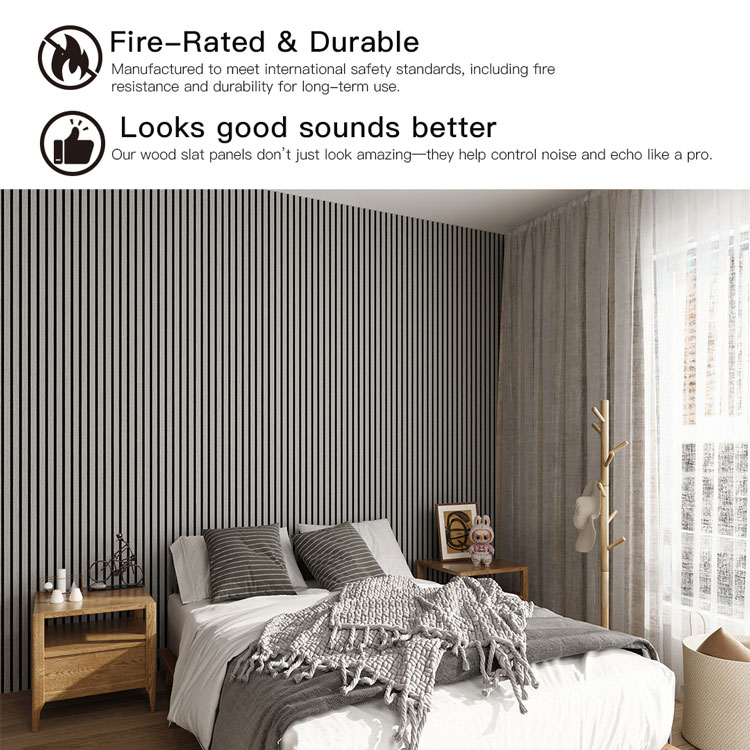
Wood slat acoustic panels combine decorative appeal with strong NRC performance when paired with high-quality acoustic backing materials.
Many people assume decorative panels cannot achieve high NRC—but modern engineering proves otherwise.
A well-designed wood slat acoustic panel achieves strong NRC by combining:
Precisely spaced wooden slats
High-density acoustic felt or polyester fiber backing
Optimized panel thickness and structure
This design allows sound waves to pass through the slats and be absorbed by the acoustic core.
Several factors influence NRC performance:
Core material density
Panel thickness
Slat spacing and geometry
Backing material quality
Installation method (air gap, wall type)
Professional manufacturers control all these variables to ensure consistent acoustic results.
Guangdong Leeyin Acoustics specializes in manufacturing wood slat wall panels and acoustic panels for global markets.
20,000㎡ modern production facility
Advanced acoustic testing and material selection
Stable NRC performance across production batches
Strict quality management in line with international standards
One of China’s leading exporters of wood slat acoustic panels
By combining precise manufacturing with acoustic engineering, we ensure our panels deliver both measured NRC performance and architectural aesthetics.
For international projects, NRC is often required in:
Architectural specifications
Commercial tenders
Green building certifications
Office and public building standards
Choosing panels with verified NRC values reduces risk and ensures compliance with acoustic design requirements.

Tel / Whatsapp : +86 13902386325 / +86 13902386325
Email :
export@gzliyin.com


© 2026 Guangdong Liyin Acoustics Technology Co., Ltd. All Rights Reserved.

Hi! Click one of our members below to chat on


