Email:export@gzliyin.com
WhatsApp:+8613902386325
Email:export@gzliyin.com
WhatsApp:+8613902386325
In modern architecture and interior design, creating a space that is both visually appealing and acoustically comfortable has become a top priority. Whether in homes, offices, hotels, or commercial environments, poor acoustics can negatively impact the user experience—even in beautifully designed spaces.
This is where acoustic panels come in. Beyond their functional benefits, acoustic panels have evolved into powerful design elements that enhance aesthetics while improving sound quality.
In this article, we’ll explore how acoustic panels enhance interior design, and why they are becoming an essential feature in contemporary spaces.
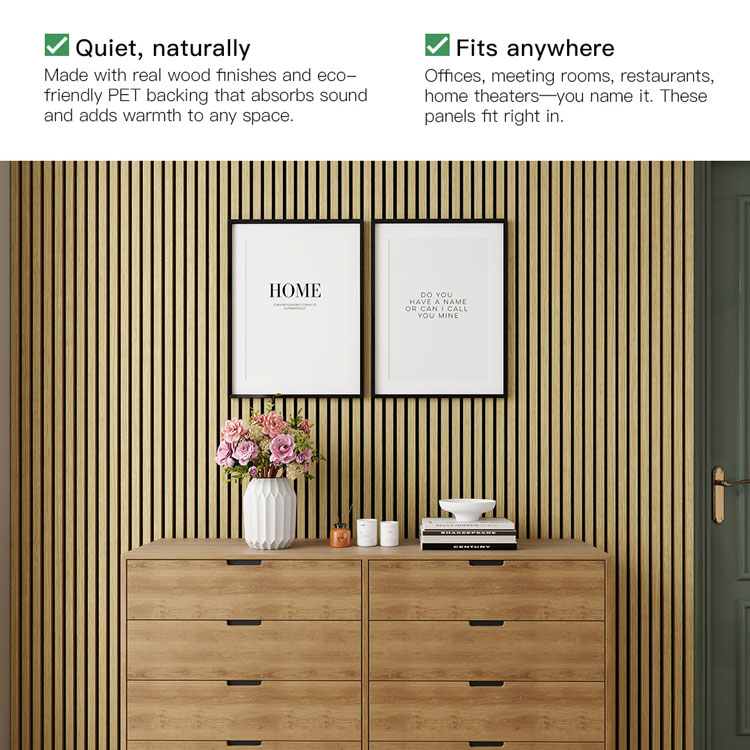
Interior design is no longer just about how a space looks—it’s also about how it feels and functions. Sound plays a critical role in this experience.
Hard surfaces such as glass, concrete, and tile reflect sound, creating:
These issues can make spaces uncomfortable, reduce speech clarity, and negatively affect productivity and relaxation.
By integrating acoustic panels into the design, you can control sound while elevating the overall visual appeal of the space.
One of the biggest advantages of modern acoustic panels is their ability to combine sound absorption with decorative design.
Unlike traditional acoustic solutions that may look purely functional, today’s panels are available in a wide range of:
This allows designers to seamlessly integrate acoustic treatment into the overall design concept.
Acoustic panels can be used to create striking feature walls that serve as focal points in a room.
A popular option is wood slat acoustic panels, which offer:
These panels are widely used in:
They not only improve acoustics but also add depth, texture, and architectural interest to walls.
Acoustic panels can influence how a space is perceived.
For example:
By carefully selecting panel design and layout, designers can enhance spatial perception while improving acoustics.
Open-plan environments, such as offices and restaurants, often struggle with noise control due to large, reflective surfaces.
Acoustic panels help:
When integrated into walls or ceilings, they maintain a clean design while solving acoustic challenges.
Acoustic panels align perfectly with popular interior design trends, including:
Wood slat acoustic panels, in particular, are highly favored for their ability to bring natural elements into modern spaces, enhancing both visual and sensory experiences.
Acoustic panels can be used in a variety of creative ways, such as:
This flexibility allows designers to use acoustic panels not just as functional elements, but as integral parts of the overall design concept.
In commercial environments, interior design plays a key role in expressing brand identity.
Custom acoustic panels can be designed to reflect:
This allows businesses to create spaces that are both acoustically comfortable and visually aligned with their brand image.
Among all acoustic solutions, wood slat acoustic panels have become one of the most popular choices for interior designers and architects.
Their structure typically includes:
This design provides:
They are widely used in:
Wood slat panels perfectly balance functionality and design, making them a preferred solution in today’s interiors.
At Guangdong Leeyin Acoustics, we specialize in manufacturing high-quality wood slat wall panels and acoustic panels that enhance both acoustic performance and interior aesthetics.
As a leading exporter of wood slat acoustic panels in China, we provide reliable solutions for global markets.
We work closely with designers, contractors, and distributors to deliver products that meet both functional and design requirements.
Our acoustic panels are widely used in residential, commercial, and architectural projects, helping create spaces that are not only beautiful but also acoustically optimized.
Tags :

Tel / Whatsapp : +86 13902386325 / +86 13902386325
Email :
export@gzliyin.com


© 2026 Guangdong Liyin Acoustics Technology Co., Ltd. All Rights Reserved.

Hi! Click one of our members below to chat on


