Email:export@gzliyin.com
WhatsApp:+8613902386325
Email:export@gzliyin.com
WhatsApp:+8613902386325
When selecting wood slat acoustic panels, many buyers focus on design, sound absorption ratings, or core materials. However, one often overlooked factor plays a crucial role in both performance and durability: veneer thickness.
In this article, we explore how veneer thickness affects acoustic panel quality, including sound performance, durability, aesthetics, and long-term value—helping architects, contractors, and distributors make informed decisions.
Veneer thickness refers to the thickness of the real wood layer applied to the surface of wood slat acoustic panels. This natural wood veneer is bonded to an MDF or acoustic core and directly influences:
Structural stability
Visual depth and texture
Wear resistance
Overall product lifespan
Not all veneers are created equal, and thickness variations can significantly affect quality.
While veneer itself is not the primary sound-absorbing element, its thickness indirectly affects acoustic performance.
Proper veneer thickness maintains the designed spacing and geometry of wood slats
Excessively thin veneers may warp or deform, altering sound diffusion patterns
Stable veneers help ensure consistent sound absorption when combined with acoustic backing materials
High-quality wood slat acoustic panels rely on a balanced veneer thickness that supports structural integrity without compromising acoustic design.
One of the most important benefits of thicker veneer is enhanced durability.
Easier to crack or chip during installation
Reduced resistance to impact and abrasion
Shorter product lifespan in high-traffic areas
Improved resistance to scratches and dents
Better performance in commercial environments
Greater stability under temperature and humidity changes
For long-term projects, veneer thickness directly impacts maintenance costs and customer satisfaction.
Veneer thickness has a strong influence on visual appearance:
Thicker veneers provide richer wood grain definition
Better surface finishing and color consistency
Enhanced premium look for modern interiors
This is especially important for architectural spaces where wood slat wall panels are both acoustic solutions and decorative features.
Thicker veneers, when sourced responsibly, can also support sustainability goals:
Longer product lifespan reduces replacement frequency
Better bonding reduces material waste
Compatible with FSC-certified wood sourcing
When combined with efficient manufacturing processes, optimal veneer thickness contributes to environmentally responsible acoustic solutions.
Guangdong Leeyin Acoustics specializes in the production of wood slat acoustic panels and acoustic wall panels, serving global markets with consistent quality.
20,000㎡ modern production facility
Advanced veneer pressing and bonding technology
Strict control of veneer thickness and tolerances
Quality management aligned with international standards
Leading exporter of wood slat wall panels in China
Our strong production capacity allows us to deliver stable veneer quality at scale, ensuring every panel meets both aesthetic and performance expectations.
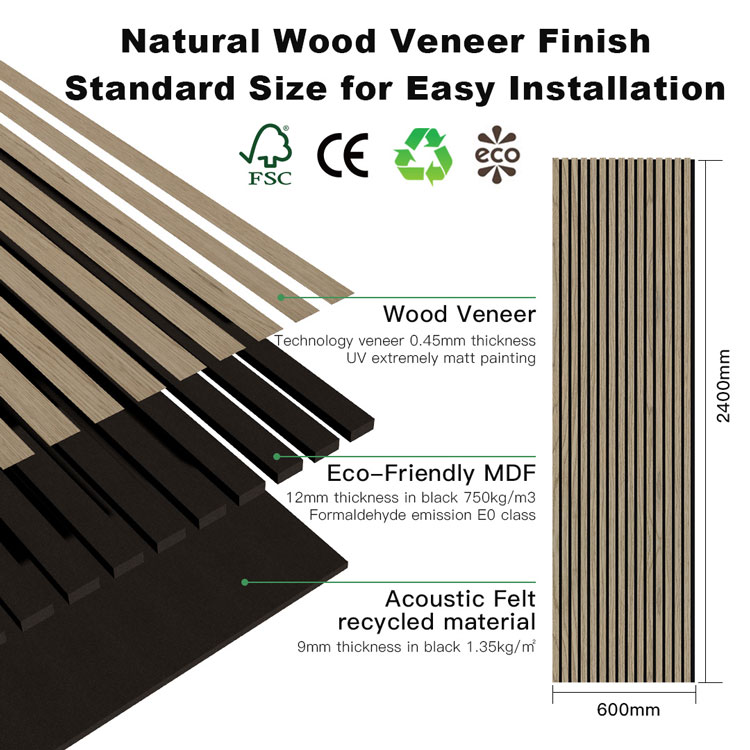
When sourcing wood slat acoustic panels, consider:
Application environment (residential vs commercial)
Expected wear and traffic levels
Visual requirements
Long-term durability needs
Manufacturer’s quality control capability
A professional supplier will provide technical specifications, stable veneer thickness, and consistent batch quality.

Tel / Whatsapp : +86 13902386325 / +86 13902386325
Email :
export@gzliyin.com


© 2026 Guangdong Liyin Acoustics Technology Co., Ltd. All Rights Reserved.

Hi! Click one of our members below to chat on


