Email:export@gzliyin.com
WhatsApp:+8613902386325
Email:export@gzliyin.com
WhatsApp:+8613902386325
Low-frequency noise is one of the most challenging acoustic problems in both residential and commercial spaces. Whether it comes from traffic, home theater subwoofers, HVAC systems, or neighboring apartments, low-frequency sound tends to travel farther and penetrate walls more easily than higher frequencies.
Many people ask: Do acoustic panels work for low-frequency noise? The answer depends on the type of acoustic panel, its thickness, and how it is installed. In this article, we’ll explore how acoustic panels interact with low-frequency sound and how to improve acoustic performance in your space.
Low-frequency noise typically refers to sounds in the 20 Hz to 250 Hz range. These sounds include:
Bass from music or home theater systems
Heavy footsteps or structural vibrations
Traffic rumble or construction noise
Mechanical equipment or HVAC systems
Unlike higher-frequency sounds such as speech or clattering objects, low-frequency waves have longer wavelengths. Because of this, they can easily pass through walls and reflect around large spaces.
This makes them significantly harder to absorb using standard acoustic treatments.
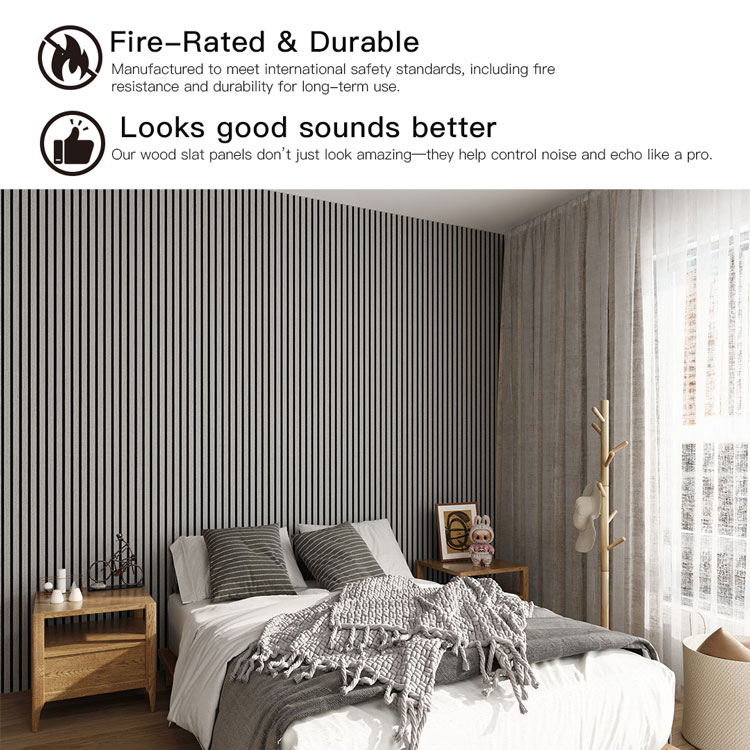
Acoustic panels are designed to absorb sound energy and reduce reflections within a room. Most panels use materials such as:
Polyester fiber
Mineral wool
Acoustic foam
Felt-based sound-absorbing cores
When sound waves hit the surface of the panel, the porous material converts sound energy into small amounts of heat, reducing echo and reverberation.
However, standard acoustic panels are most effective at mid- and high-frequency sound absorption, which includes speech, office noise, and everyday household sounds.
The short answer is: standard acoustic panels only partially help with low-frequency noise.
Because low-frequency waves are longer and more powerful, they require thicker and denser acoustic materials to be effectively absorbed. Thin decorative panels or lightweight materials may not significantly reduce deep bass sounds.
However, acoustic panels can still contribute to improved sound control in several ways.
Even if they do not fully absorb deep bass, acoustic panels reduce reflections and reverberation in the room. This helps prevent bass buildup and acoustic imbalance, improving the overall listening experience.
By controlling mid- and high-frequency reflections, acoustic panels make voices and music clearer, even when low-frequency sounds are present.
In many cases, acoustic panels work best when combined with other acoustic solutions such as:
Bass traps
Acoustic ceiling panels
Sound insulation materials
Together, these elements create a balanced acoustic environment.
If low-frequency noise is your main concern, several strategies can improve performance.
Panels with greater thickness and density can absorb lower frequencies more effectively. Thicker panels provide deeper sound absorption and help manage bass reflections.
Mounting acoustic panels slightly away from the wall can improve low-frequency absorption. The air gap allows sound waves to penetrate deeper into the panel, increasing acoustic efficiency.
Bass traps are specifically designed to absorb low-frequency sound. They are typically placed in room corners where bass energy tends to accumulate.
The more acoustic treatment installed in a room, the more effective it becomes. Covering multiple surfaces—walls, ceilings, and corners—helps control both high and low frequencies.
Modern wood slat acoustic panels offer a combination of sound absorption and interior design enhancement. These panels typically consist of:
Decorative natural wood or MDF slats
Sound-absorbing acoustic felt backing
Precision-engineered spacing for improved acoustic performance
This structure allows the panels to reduce echo and reverberation while maintaining a sophisticated architectural appearance.
While they primarily target mid- and high-frequency sound, when installed correctly and combined with other acoustic treatments, wood slat panels can contribute to a more balanced acoustic environment.
Acoustic panels are widely used in spaces where sound quality and comfort are important, including:
Home theaters
Recording studios
Offices and meeting rooms
Restaurants and cafés
Hotels and commercial interiors
Residential living spaces
In these environments, controlling reflections and reverberation significantly improves speech clarity, listening comfort, and overall acoustic quality.
At Guangdong Leeyin Acoustics, we specialize in the design and manufacturing of wood slat wall panels and acoustic panels for global markets.
As one of the leading exporters of wood slat acoustic panels in China, we provide high-quality products backed by strong production capabilities.
Our advantages include:
20,000 square meters of modern manufacturing facilities
Advanced production equipment and technology
Strict quality management following international standards
Large-scale production capacity for global distribution
Extensive experience supplying architectural and commercial projects worldwide
Our wood slat acoustic panels are designed to combine acoustic performance, durability, and modern architectural aesthetics, making them ideal for designers, contractors, and distributors.
So, do acoustic panels work for low-frequency noise?
Standard acoustic panels are most effective at reducing mid- and high-frequency reflections, but they can still play an important role in managing overall room acoustics. When combined with thicker materials, proper installation techniques, and additional acoustic treatments such as bass traps, they can contribute to better control of low-frequency sound.
For projects that require both sound control and modern interior design, wood slat acoustic panels offer an excellent solution.
If you are looking for high-quality acoustic panels for residential or commercial projects, Guangdong Leeyin Acoustics provides professional manufacturing, reliable quality, and strong global supply capabilities.

Tel / Whatsapp : +86 13902386325 / +86 13902386325
Email :
export@gzliyin.com


© 2026 Guangdong Liyin Acoustics Technology Co., Ltd. All Rights Reserved.

Hi! Click one of our members below to chat on


